
Mare’s tail, also known as horsetail (Equisetum arvense), is a persistent, deep rooted invasive weed found across Great Britain. It spreads quickly, survives in poor conditions, and resists most standard removal methods. As a result, many property owners struggle to control it once established.
Understanding how to identify mare’s tail and apply the correct treatment is essential for long term control. Early action can prevent the weed from spreading further and reduce the cost and complexity of removal.
Mare’s tail is an ancient plant species that spreads through a dense underground rhizome network. These roots can extend more than 2 metres below ground level, making the plant extremely difficult to remove.
This deep root system allows mare’s tail to survive drought, poor soil conditions, and repeated attempts at removal. Even small root fragments can regenerate into new plants, allowing the infestation to persist and spread.
Unlike many common weeds, mare’s tail does not rely solely on visible growth. Instead, it continues to expand underground, often spreading unnoticed before appearing in new areas.
You will commonly find mare’s tail in gardens, borders, lawns, driveways, and paved areas. It can push through cracks in hard surfaces and quickly establish itself across large areas if left untreated.

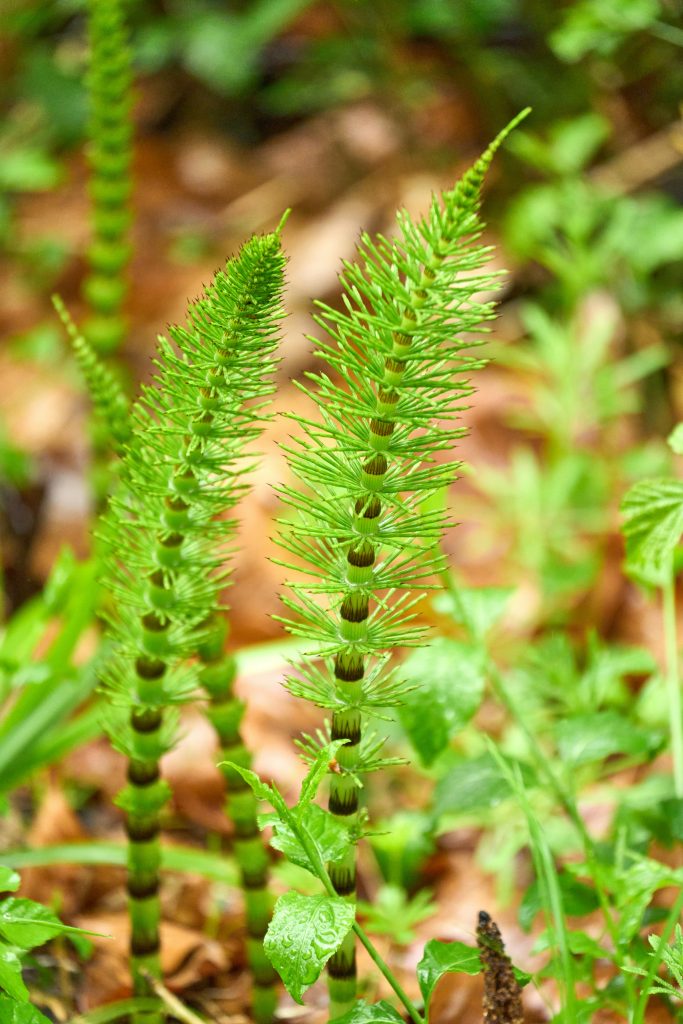
Mare’s tail has a distinct life cycle, and its appearance changes with the seasons. Recognising these stages will help you identify the plant early.
In early spring, mare’s tail produces pale brown or beige stems with a cone shaped tip. These fertile shoots do not have leaves and are often mistaken for small mushrooms or emerging shoots.
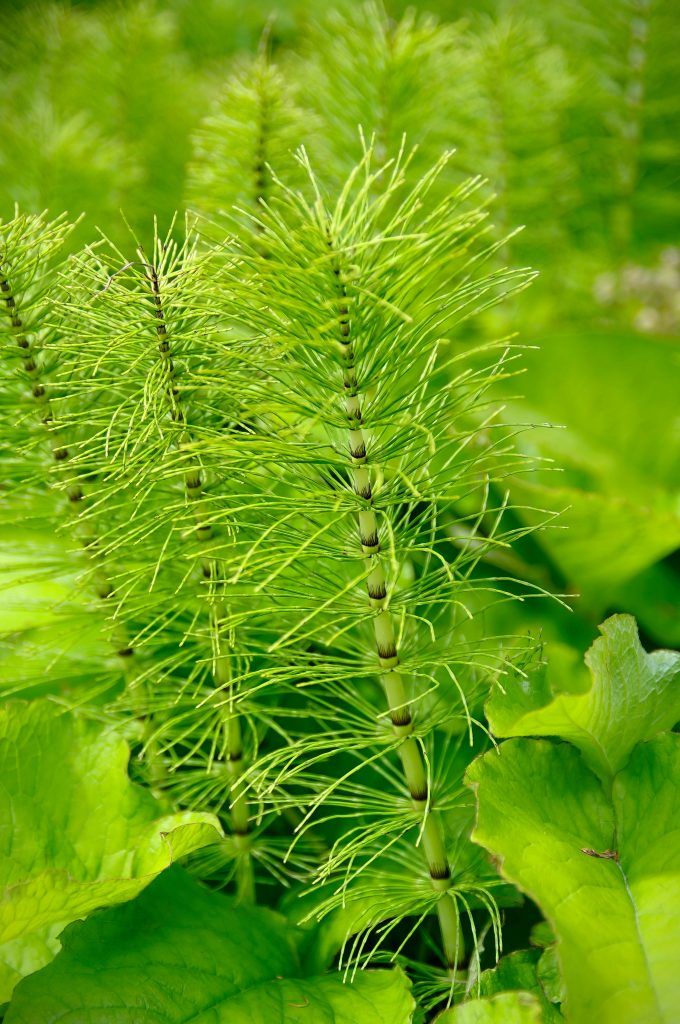
As the season progresses, these stems die back and are replaced by green, upright shoots. These sterile stems feature fine, needle like leaves arranged in circular whorls, giving the plant a structure similar to a small fir tree.
Mature plants typically grow up to 60cm tall and form dense clusters. Over time, these clusters can spread rapidly and dominate garden spaces.
Accurate identification is critical. Mare’s tail is often confused with other upright weeds, which can lead to ineffective treatment and ongoing problems.
Mare’s tail is one of the most challenging invasive weeds to control in the UK. Its strength lies in its underground rhizome system and its ability to regenerate from even the smallest fragments.
When you pull or disturb the plant, you often break the roots into smaller pieces. Each of these fragments can develop into a new plant, making the infestation worse.
Shallow weeding and occasional removal rarely solve the problem. In most cases, they only provide short term relief while allowing the root system to continue spreading.
This is why many DIY approaches fail. Without targeting the root system properly, mare’s tail will continue to return year after year.
To control mare’s tail successfully, you need a consistent and well planned approach. The most effective methods focus on weakening the plant over time and limiting regrowth.
Manual Control
Regular cutting or pulling can reduce the plant’s energy over time. However, this method requires persistence and will not fully remove the root system. It is best used as part of a wider treatment strategy.
Herbicide Treatment
Herbicide treatment is commonly used to control mare’s tail. However, the plant’s waxy coating and deep roots make it resistant to many standard treatments. Multiple applications are usually required over several growing seasons to achieve noticeable results.
Professional Weed Management
For established infestations, professional treatment offers the most reliable results. Specialists can assess the extent of the spread and apply targeted treatments designed to weaken the rhizome system and prevent regrowth.
A structured treatment plan will significantly improve the chances of long term control.
You should act as soon as you identify mare’s tail on your property. Early intervention reduces the spread and makes treatment far more effective.
If you delay treatment, the plant will continue to expand underground and appear in new areas. This increases both the cost and the time required to bring the infestation under control.
Consistent treatment over time is key. Mare’s tail cannot be removed with a single application or quick fix. Instead, it requires a planned approach and ongoing management.
If you suspect mare’s tail on your property, or you are struggling to control an existing infestation, professional advice can help you move forward with confidence.
We can arrange a detailed site survey to assess the extent of the infestation and identify the most effective treatment approach. You will receive a clear, tailored plan designed to control and manage mare’s tail on your property.
Our team focuses on practical, long term solutions that reduce regrowth, protect your outdoor space, and prevent further spread.
What is Common Ragwort?
What Can Be Mistaken For Japanese Knotweed?
Giant Hogweed
For more articles like this, visit our news page.