









For developers and companies dealing with Japanese knotweed, remediation can represent a significant additional cost within a development or land acquisition. However, some companies may qualify for Land Remediation Relief, a Corporation Tax relief designed to support companies bringing affected land back into productive use.
Japanese knotweed is specifically recognised within HMRC’s Land Remediation Relief rules. However, eligibility depends on the company, the circumstances of the infestation, the expenditure incurred and the method used to remediate the site.
This guide explains how Land Remediation Relief applies to Japanese knotweed, what the deduction (historically as much as 150%) actually means and what businesses should consider when planning remediation work.

Corporate development projects

Companies investing in or managing property

Companies that own land requiring qualifying remediation

Land Remediation Relief is a Corporation Tax relief
Japanese knotweed is specifically recognised within HMRC’s Land Remediation Relief guidance due to the problems it can create for the use and redevelopment of land. As a result, some of the usual conditions applying to contaminated land work differently where Japanese knotweed is involved.
One of the most important differences is regarding when the infestation occurred. For many contaminated-land claims, the land must already have been contaminated when it was acquired. That acquisition condition does not apply to Japanese knotweed in the same way. A qualifying company may therefore still be able to claim relief where knotweed was introduced after it acquired the site. HMRC specifically gives fly-tipping as an example.
There is also an important responsibility on the landowner to act appropriately once the infestation is known. HMRC states that a company that fails to take appropriate action and allows Japanese knotweed to spread can be treated as the polluter and lose access to the relief. Obtaining suitable specialist advice and acting in accordance with it can demonstrate that appropriate remedial action is being taken.
Potentially, yes.
Japanese knotweed is specifically named within HMRC’s Land Remediation Relief guidance.
This is particularly important because Japanese knotweed receives slightly different treatment from many other forms of contamination.
Ordinarily, Land Remediation Relief for contaminated land requires the company to have acquired land that was already in a contaminated state. For Japanese knotweed, the infestation does not necessarily have to have been present when the land was acquired.
HMRC gives the example of Japanese knotweed subsequently being introduced to a site through fly-tipping.
That distinction can make the relief relevant to a wider range of development sites where Japanese knotweed has appeared or spread after acquisition.
Land Remediation Relief is a Corporation Tax relief, so it is principally relevant to companies.
It is not generally available to private individuals or ordinary partnerships, although HMRC provides specific provisions for companies that are members of partnerships.
For property and development projects, this means the relief may potentially be relevant to organisations such as property development companies, commercial property businesses and other corporate landowners carrying out qualifying remediation.
Eligibility should always be assessed against the individual circumstances of the company and site.
Not every cost associated with a development automatically becomes qualifying expenditure simply because Japanese knotweed is present.
HMRC states that qualifying remediation expenditure must arise as a result of the contaminated or derelict condition of the land. For current claims, qualifying categories can include expenditure on staffing, materials and qualifying remediation work contracted to another party. The expenditure must also meet the other conditions of the scheme.
Professional fees for advice on how to remove contamination may also form part of qualifying remediation costs in appropriate circumstances.
For a Japanese knotweed project, potentially relevant expenditure could therefore relate to areas such as:
● specialist investigation and advice directly connected with the infestation;
● qualifying Japanese knotweed treatment or remediation works;
● relevant materials used as part of the remediation;
● qualifying specialist contractor costs; and
● other expenditure incurred specifically because remediation of the affected land is required.
The exact treatment of individual costs should be assessed by a specialist Land Remediation Relief adviser rather than assumed from the project invoice alone.
The remediation method matters.
Japanese knotweed on development sites may be dealt with through herbicide treatment, excavation, on-site management, specialist soil treatment or a combination of methods depending on the site constraints and development programme.
HMRC confirms that Japanese knotweed remediation can qualify for Land Remediation Relief, but there is an important exclusion where affected material is disposed of at landfill.
Another important condition is HMRC’s polluter pays principle.
A company cannot generally claim Land Remediation Relief where it, or a connected party, was responsible through its actions or inaction for causing the contamination.
For Japanese knotweed, this includes situations where a company fails to take appropriate action and consequently allows an infestation to spread.
HMRC does, however, recognise that Japanese knotweed treatment is not always immediate. Its guidance states that a company may still be regarded as taking appropriate remedial action where it obtains suitable specialist advice and acts in accordance with that advice. For example, a treatment programme may need to wait until the appropriate growing season.
This is another reason why obtaining professional advice and documenting the management of Japanese knotweed from an early stage can be important.
Tax relief should not dictate how Japanese knotweed is managed. The treatment or remediation strategy needs to respond to the infestation, the proposed development, site conditions, environmental requirements and programme.
However, there can be advantages to considering Land Remediation Relief before the remediation works are finalised.
Early consideration gives the project team an opportunity to understand which areas of expenditure may be relevant, ensure costs are clearly identified and retain useful supporting information throughout the project.
It can also prevent the tax position from being considered only after invoices have been consolidated into broader construction costs, making it more difficult to distinguish the expenditure directly connected with Japanese knotweed remediation.
A specialist adviser assessing a potential claim may need to understand both what was done and why the expenditure was incurred.
For a Japanese knotweed project, useful technical information can include survey findings, the extent of the affected area, remediation or management plans, details of the method used, contractor documentation, site records and clearly identified remediation expenditure.
On excavation projects, records relating to the excavation, movement, treatment and final destination of affected soils can provide an important technical record of how the infestation was managed.
This is where specialist remediation documentation and commercial tax advice need to work alongside one another.
Potentially.
HMRC allows Land Remediation Relief claims to be made through a company’s Corporation Tax Self Assessment, including an amended Self Assessment where the relevant claim time limits remain open. Separate timing requirements apply to elections concerning qualifying capital expenditure.
A company that has already paid for Japanese knotweed remediation should therefore not automatically assume that it is too late.
The expenditure and accounting period should be reviewed by a suitably qualified tax adviser to establish whether a valid claim can still be made.
The rules should be checked at the point a claim is considered.
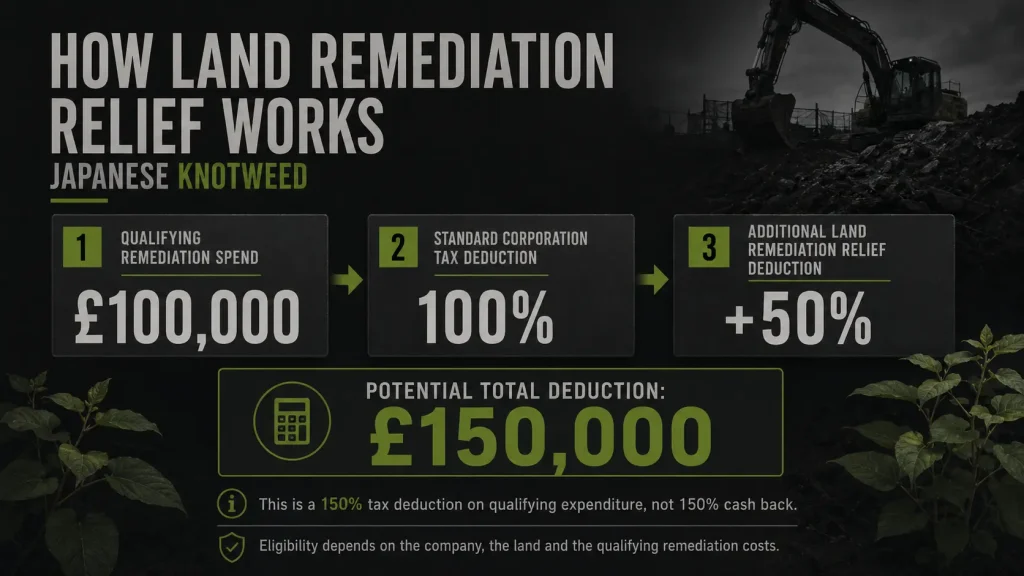
As of August 2026, HMRC’s current guidance continues to describe Land Remediation Relief as a 100% deduction plus an additional 50% deduction for qualifying expenditure.
However, HM Treasury opened a further consultation on 13 July 2026 considering possible reforms to the relief, including changes relating to when relief is given and how eligible contamination expenditure interacts with the planning process.
Businesses planning future remediation should therefore obtain up-to-date advice rather than relying on historic assumptions about eligibility.
It means qualifying expenditure can generate the normal 100% deduction plus an additional 50% deduction for Corporation Tax purposes. It does not mean HMRC reimburses 150% of the cost.