
If you’re buying or selling a home in Stoke-on-Trent, Japanese knotweed, as an invasive plant species, usually comes into focus once a transaction is underway. It’s typically identified through routine checks rather than proactive searches, with questions often arising when deadlines are already in play.


Most people don’t go looking for Japanese knotweed. It usually surfaces during due diligence—a survey raises a question, a buyer seeks reassurance, or a lender requests confirmation. At that point, uncertainty can matter more than the plant itself.
In Stoke-on-Trent, residential areas include established housing alongside zones shaped by phased redevelopment and changing boundaries. Here, knotweed is treated as a due-diligence issue—confirmed through professional assessment rather than assumed to be present.
What matters most is how quickly any uncertainty is clarified once it arises.
In Stoke-on-Trent, knotweed concerns usually arise during standard transaction checks, rather than because a property is assumed to be affected.
Typical points include:
At this stage, delays are often linked to missing or incomplete information rather than the underlying issue itself.
When knotweed questions are addressed promptly, they can usually be resolved without affecting timelines. Delayed clarification, even for minor issues, can disrupt progress—especially when completion dates or onward purchases are involved. Late clarification can lead to a Japanese knotweed infestation impacting property value, therefore, once identified, a management plan needs to be put into place.
For many Stoke-on-Trent transactions, the real risk isn’t the plant itself, but uncertainty arising at a late stage.
Clear evidence early preserves options later.
| Situation | Why clarity is needed |
|---|---|
| Selling a property | Unresolved questions can pause buyer decision-making close to exchange |
| Buying a property | Early clarity helps avoid renegotiation or delay after commitment |
| Residential landowners | Knotweed considerations still need to be assessed and recorded appropriately |
Properly assessed and managed Japanese knotweed does not automatically block property transactions or development in Stoke-on-Trent.
However, unresolved questions can trigger extra scrutiny from lenders, surveyors, or legal advisers—often at the least convenient stage.
We provide professional Japanese knotweed surveys, treatment and removal services throughout Stoke-on-Trent, including Burslem, Tunstall, Longton, Hanley, Fenton and surrounding areas, as well as nearby towns such as Kidsgrove, Talke, Chell, Norton-in-the-Moors and Smallthorne.
If Japanese knotweed is mentioned during a sale or purchase, the best next step is to clarify the situation early with site-specific advice, rather than relying on assumptions.
We establish whether a formal Japanese knotweed assessment is actually needed, based on your specific situation rather than assumptions.
We advise on what type of reporting would be appropriate, proportionate and acceptable to lenders, solicitors or planners.
By dealing with likely questions at the right stage, we help prevent delays, disputes or last-minute requests later in the process.
Handled early, knotweed becomes a managed factor, not a lingering constraint.
A private residential property in Stoke-on-Trent contained two Japanese knotweed stands, each around 2.5 m tall, located on opposite sides of the garden.
Survey findings prompted enquiries regarding potential cross-boundary root spread and the impact on the transaction timeline.
A professional assessment confirmed both stands, and a documented herbicide programme with exclusion measures provided a clear management record.
With documented management in place, the sale proceeded without timing disruptions, with treatment costs estimated at £2,487.00 + VAT.
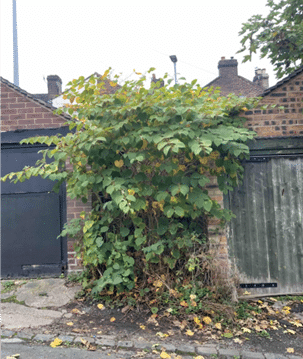
Yes. We carry out Japanese Knotweed excavation and removal across Stoke-on-Trent, including Hanley, Burslem, Tunstall, Longton, Fenton, and Stoke town. We work on residential, commercial, and redevelopment sites throughout the city.
Japanese Knotweed is commonly found in Stoke-on-Trent, particularly around former industrial land, canal corridors, railway lines, and brownfield sites. Historic ground disturbance linked to the city’s industrial past has contributed to its spread.
Excavation is often recommended in Stoke-on-Trent when:
A property sale or mortgage approval is time-sensitive
Knotweed is close to buildings, walls, or drains
Groundworks or redevelopment are planned
Excavation offers a fast and permanent solution, making it suitable for urgent situations.
All excavated Japanese Knotweed material is treated as controlled waste under UK legislation. It is removed by licensed waste carriers and disposed of at approved landfill facilities that accept invasive plant material, in line with local Stoke-on-Trent requirements.
Prior to excavation, we complete a site-specific risk assessment, particularly important in Stoke-on-Trent’s terraced housing areas and shared boundaries. All work is carefully managed to minimise disruption and prevent the spread of knotweed to neighbouring land.
Yes. Our Japanese Knotweed excavation projects in Stoke-on-Trent can be supplied with a long-term company guarantee, with the option of an insurance-backed guarantee. These are commonly required by mortgage lenders, surveyors, and solicitors.