


Does Knotweed Require Action?
Most people don’t actively look for Japanese knotweed. It usually comes to light during due diligence—when a survey flags a potential issue, a buyer seeks reassurance, or a lender requests confirmation. At that point, managing uncertainty can be more important than managing the plant itself.
Bristol features a wide mix of urban residential housing and private gardens. In all cases, Japanese knotweed is treated as a formal due-diligence matter, identified through professional assessment rather than assumed to be present.
In most cases, the key factor isn’t the discovery itself, but how quickly the situation is clarified so decisions can proceed without disruption.
Knotweed Triggers in Bristol
In Bristol, Japanese knotweed questions usually arise during surveys, rather than because a property is assumed to be affected.
Common trigger points include:
- A surveyor identifying a potential concern during inspection
- Follow-up enquiries raised during conveyancing
- Requests for clarification before a transaction moves to the next stage
Where information isn’t yet available, even small uncertainties can introduce delays.
Why Early Clarity Makes a Difference
When Japanese knotweed questions are addressed early, they can be resolved efficiently without affecting agreed timescales. If clarification comes later—once momentum has built—uncertainty can slow progress or pause decisions. Japanese knotweed infestations can impact property value, causing substantial financial implications, so if present, it needs to be identified promptly.
For transactions in Bristol, timing is often the key factor: providing clear information at the right stage helps keep matters moving.
What This Means
Across all scenarios, the pattern is consistent: clarity early supports smoother progress later.
| Situation | Why clarity is needed |
|---|---|
| Selling a property | Surveys may raise questions that need clear, timely responses. |
| Buying a property | Early confirmation helps avoid issues emerging after commitment. |
| Urban residential properties | Knotweed is assessed as part of standard due diligence, alongside other property checks. |
Japanese knotweed does not automatically block property transactions in Bristol when it is properly assessed and documented.
However, if questions remain unanswered, surveyors or legal advisers may pause progress until clarity is provided—usually affecting timing rather than the outcome.
Your Next Step
If Japanese knotweed has been mentioned—or you’re concerned it may be present—the best next step is to get site-specific advice rather than rely on assumptions. Once advice has been given, a treatment plan can be arranged.
Confirming whether an assessment is required
We establish whether a formal Japanese knotweed assessment is actually needed, based on your specific situation rather than assumptions.
Understanding what information is needed to keep matters moving
We advise on what type of reporting would be appropriate, proportionate and acceptable to lenders, solicitors or planners.
Addressing likely questions before they affect timing
By dealing with likely questions at the right stage, we help prevent delays, disputes or last-minute requests later in the process.
Early clarification often prevents avoidable delays later on.
Bristol Case Study
Site Context
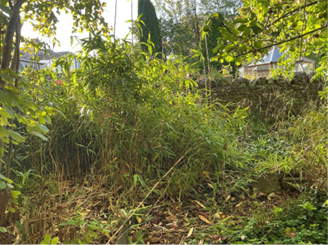
A private garden in Bristol contained a Japanese knotweed stand of about 5 m², with neighbouring properties also showing visible growth.
The Issue
Nearby off-site growth posed a risk of underground rhizome spread, so a coordinated management plan was needed to prevent reinfestation.
Assessment & Response
A professional assessment confirmed the on-site stand as the main source. A treatment programme using targeted spraying and stem injection with a glyphosate-based herbicide was recommended for long-term control.
Outcome
The management plan gave buyers and surveyors clear guidance, allowing the transaction to proceed on schedule, with indicative costs of £4,582.32 + VAT.
Japanese Knotweed in Bristol FAQs
Frequently asked questions
Yes. We carry out Japanese Knotweed excavation and removal across Bristol, including areas such as Clifton, Redland, Bedminster, Southville, Fishponds, and surrounding districts. Both residential and commercial properties are covered, subject to access arrangements and site conditions.
Japanese Knotweed is common in Bristol due to its extensive waterways, transport infrastructure, and historic industrial activity. Infestations are often found along the River Avon and Frome, railway corridors, redevelopment sites, and older urban land.
Excavation is typically recommended where:
A property transaction or remortgage is time-sensitive
Development, extensions, or groundwork are planned
Knotweed is growing close to buildings, boundaries, or retaining walls
In these situations, excavation usually offers a faster and more definitive solution than long-term herbicide treatment.
All excavated Japanese Knotweed material is classified as controlled waste. We use licensed waste carriers and dispose of the material at approved landfill facilities authorised to accept invasive plant waste, in compliance with local and national regulations.
Before excavation begins, we complete a site-specific risk assessment, particularly for terraced housing, shared boundaries, public pathways, and land near watercourses. Works are carefully managed to prevent disturbance or spread beyond the site.
Yes. Our excavation works in Bristol can be provided with a long-term guarantee, with insurance-backed options available. These guarantees are commonly required by lenders, solicitors, and surveyors during property transactions.