
Japanese knotweed removal in Staffordshire requires an approach suited to the property, the extent of the infestation and how the land will be used.
Our Staffordshire-based team provides professional treatment and removal solutions for residential, commercial and development sites across the county.


Most people don’t actively look for Japanese knotweed. It usually comes to light during due diligence—when a survey raises a question, a buyer seeks reassurance, or a lender requests confirmation. At that stage, managing uncertainty can be more important than managing the plant itself.
Properties across Staffordshire range from long-established residential areas to sites shaped by historic industry and incremental development. In these cases, Japanese knotweed is treated as a formal due-diligence matter, identified and addressed through professional assessment rather than assumed to be present.
What often determines the outcome is how quickly the situation is clarified and how clearly it is documented.
In Staffordshire, Japanese knotweed concerns usually arise during routine due diligence, rather than because a property is assumed to be affected.
Common trigger points include:
This is often when people realise that delaying action can reduce the options available. Identifying the extent of the infestation early leaves more time to choose an appropriate treatment or removal strategy before transactions, development programmes or planned works are affected.
When Japanese knotweed is identified early, there is usually more flexibility in how it can be managed. A planned treatment programme may be appropriate where time allows, while excavation can be considered where development, construction or other site works require a faster solution. For landowners and commercial sites, the approach may also need to account for contaminated soil, access, future land use and how affected material will be managed.
Delays can make these decisions more difficult. Where knotweed is discovered after offers have been agreed, development timescales are fixed or works are already underway, it can lead to additional cost, renegotiation or disruption. Establishing the extent of the infestation early allows an appropriate management plan to be put in place and gives property owners, buyers and landowners in Staffordshire a clearer route forward.
Addressing Japanese knotweed early helps preserve the options available later.
| Situation | Why clarity is needed |
|---|---|
| Selling a property | Establishing the extent of an infestation and how it will be managed can help answer buyer questions before they cause unnecessary delays. |
| Buying a property | Understanding the extent of Japanese knotweed and the proposed treatment approach helps avoid unexpected issues once financial or legal commitments are underway. |
| Land or development sites | Early identification allows treatment, excavation requirements and the management of affected soil to be considered before groundworks or development begins. |
Japanese knotweed does not automatically prevent a property transaction or development in Staffordshire. What matters is understanding the extent of the infestation and having an appropriate strategy for managing it.
If Japanese knotweed is found during a survey or transaction check, the best next step is to get a management plan in place by a PCA accredited surveyor.
We establish where Japanese knotweed is present, the extent of the affected area and the site conditions that need to be considered before treatment or removal begins.
The recommended approach depends on the site, available timescales and future use of the land. This may include a structured herbicide treatment programme or excavation where faster removal is required.
The agreed approach is set out clearly so that property owners, landowners and other parties understand how the infestation will be managed and what happens next.
Handled early, Japanese knotweed can be managed as part of the wider plans for the property or site.
A private semi-detached residential property in Staffordshire was undergoing an active sale when concerns about Japanese knotweed were raised. The property was located adjacent to historic industrial land, making it particularly important to establish the extent of the infestation and put an appropriate management strategy in place.
During survey enquiries, Japanese knotweed was identified as a potential issue for the property transaction. A site assessment confirmed approximately 13 m² of Japanese knotweed, creating a need for a clear treatment approach that could address the infestation while also providing certainty for the property owner and other parties involved in the sale.
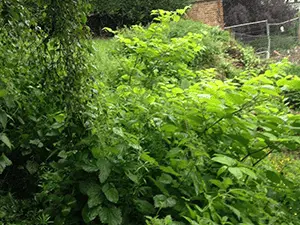
Following assessment of the site, a herbicide treatment programme was specified as the appropriate method of managing the infestation. The proposed treatment was formally documented within a Japanese knotweed management plan, setting out a structured approach for controlling the plant over the required treatment period.
This provided a clear record of how the Japanese knotweed would be managed and demonstrated that an appropriate professional treatment programme was in place.
With the extent of the Japanese knotweed established and a documented treatment programme in place, the uncertainty surrounding the infestation could be addressed. The property transaction was able to proceed without further delay, while the Japanese knotweed remained subject to an appropriate long-term management approach.
Japanese Knotweed Expert provides professional Japanese knotweed removal and treatment across Staffordshire for homeowners, landowners, commercial sites and development projects. Depending on the site, this may involve a structured herbicide treatment programme or Japanese knotweed excavation where faster removal is required for planned works or redevelopment.
From our Staffordshire base, we provide site-specific management solutions across the county, including Stafford, Stoke-on-Trent, Newcastle-under-Lyme, Cannock, Lichfield and Burton-upon-Trent.
Contact our team to discuss the most appropriate Japanese knotweed treatment or removal approach for your property or land.
Yes. We carry out Japanese Knotweed excavation and removal throughout Staffordshire, including areas such as Stoke-on-Trent, Stafford, Newcastle-under-Lyme, Cannock, Burton-upon-Trent, and Lichfield. Both residential and commercial sites are covered, subject to access and waste-handling requirements.
Japanese Knotweed is well established across Staffordshire, particularly along canal networks, railway lines, rivers, brownfield sites, and older industrial land. Former mining and redevelopment areas are especially susceptible due to historic ground disturbance.
Excavation is often recommended in Staffordshire where:
In many cases, excavation provides a faster, permanent solution compared to long-term herbicide treatment.
All excavated Japanese Knotweed material is classified as controlled waste and is transported under the Environmental Protection Act 1990. We use licensed waste carriers and dispose of material at approved landfill facilities that accept invasive plant waste, in line with local Staffordshire regulations.
Before any excavation in Staffordshire, we carry out a site-specific risk assessment, particularly for terraced housing, shared boundaries, canals, and public land. Excavation is carefully managed to prevent disturbance or spread onto neighbouring properties.
Yes. Our Japanese Knotweed excavation projects in Staffordshire can be supplied with a long-term guarantee, with the option of insurance-backed protection. This is often required by lenders, solicitors, and surveyors when buying or selling property.