
When buying, selling, or remortgaging in Wolverhampton, Japanese knotweed, as an invasive plant species, typically only becomes apparent once the transaction or lending process has started.


Most people don’t actively look for Japanese knotweed. It usually comes to light during due diligence — when a survey raises a concern, a buyer seeks reassurance, or a lender requests confirmation before proceeding. At that stage, uncertainty can have a greater impact than the plant itself.
In Wolverhampton, the area includes dense residential streets, private gardens, and semi-urban plots, where Japanese knotweed is treated as a due-diligence issue. Professionals identify and document its presence rather than assuming it exists. The key is establishing clarity early so surveyors, lenders, and advisers can progress without delay.
In most cases, the outcome depends on how quickly the situation is clarified and how clearly it is documented.
In the West Midlands, knotweed questions typically appear during surveys or buyer/lender enquiries.
Common trigger points include:
Delays generally stem from unresolved questions rather than the presence of the plant itself.
Addressing Japanese knotweed concerns promptly allows transactions and lending processes to move forward without interruption. Delayed clarity can create pressure, leading to additional checks or rescheduled inspections that affect timelines.
Providing early confirmation and documented evidence helps maintain confidence and ensures smoother progress, particularly in dense residential or semi-urban properties across the West Midlands, it also helps to prevent the spread of a Japanese knotweed infestation.
Clear documentation at the right stage reduces bottlenecks and supports transaction or lending timelines.
| Situation | Why clarity is needed |
|---|---|
| Selling a property | Surveys provide clarity to advisers and lenders. |
| Buying a property | Early identification of potential knotweed concerns prevents delays after commitment. |
| Private and dense residential plots | Knotweed is treated as part of standard due diligence. |
Japanese knotweed does not automatically prevent property transactions or remortgaging when properly assessed.
If questions remain unanswered, lenders or advisers may hold up the process until clarity is established, affecting scheduling rather than the transaction itself.
We provide professional Japanese knotweed surveys, treatment and removal services throughout the West Midlands, including major towns and cities such as Birmingham, Wolverhampton, Solihull, Stourbridge and Wednesbury, as well as surrounding towns and villages.
If Japanese knotweed is mentioned, or you suspect it may be present, the most effective next step is to seek site-specific advice.
We establish whether a formal Japanese knotweed assessment is actually needed, based on your specific situation rather than assumptions.
We advise on what type of reporting would be appropriate, proportionate and acceptable to lenders, solicitors or planners.
By dealing with likely questions at the right stage, we help prevent delays, disputes or last-minute requests later in the process.
Handled early, knotweed becomes a managed factor, not a lingering constraint.
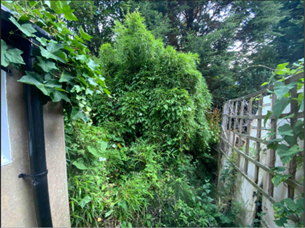
A private, densely built residential property in Wolverhampton with a Japanese knotweed stand covering approximately 810 m² across multiple areas of the plot.
The extensive infestation created a high risk of rhizome spread within the property and potentially along boundaries, requiring a coordinated management approach.
After a detailed on-site assessment, our team confirmed the full extent of the Japanese knotweed. We put forward a targeted treatment programme, combining spraying and stem injection with a glyphosate-based herbicide, to ensure long-term control and smooth the remortgage process.
Our documented management plan gave advisers and lenders a clear, site-specific overview, supporting the treatment programme’s progression and outlining indicative costs of £27,920.40 + VAT.
Yes. We provide Japanese Knotweed excavation and removal throughout the West Midlands, including Birmingham, Wolverhampton, Coventry, Dudley, Walsall, Solihull, and surrounding areas. Both residential and commercial sites are supported, with full compliance to access and waste-handling regulations.
In the West Midlands, Japanese Knotweed is often found along rivers, canals, former industrial sites, railway corridors, and brownfield land. Urban redevelopment areas and locations with historic ground disturbance are particularly prone to infestations.
Excavation is usually recommended where:
In many cases, excavation provides a faster, permanent solution compared to long-term herbicide treatment.
All excavated Knotweed material is classified as controlled waste under UK environmental legislation. Licensed waste carriers transport the material to approved landfill sites authorised to accept invasive plant waste, in full compliance with West Midlands regulations.
We carry out a detailed site-specific risk assessment, particularly for terraced housing, shared boundaries, canals, and public land. Excavation is carefully managed to prevent spread and disturbance onto neighbouring properties.
Yes. Excavation projects in the West Midlands can be supplied with long-term guarantees, including insurance-backed options. These guarantees are often required by mortgage lenders, solicitors, and surveyors during property transactions.