
If you’re buying, selling, or managing residential property in Surrey, Japanese knotweed, as an invasive plant species, is most often identified through professional surveys rather than everyday observation. It typically comes into focus when a transaction, refinance, or formal inspection prompts the need for documented reassurance.


Most people don’t actively search for Japanese knotweed. It usually comes to light during due diligence — when a survey raises a concern, a buyer seeks reassurance, or a lender requests confirmation before proceeding. At that stage, uncertainty can have a bigger impact than the plant itself.
In Surrey, where many properties are detached and high-value, Japanese knotweed is treated as a due-diligence matter. Professionals assess and document its presence rather than leaving it to assumption, from then, if Japanese knotweed is present, removal services can be arranged.
In most cases, the outcome depends on how clearly the situation is documented when lenders or advisers raise questions.
In Surrey, routine inspections usually uncover Japanese knotweed, rather than it being assumed to be present.
Common trigger points include:
Delays tend to occur when information is incomplete, not when a clear, documented position is already available.
Addressing Japanese knotweed concerns early allows them to be managed proportionately, usually without affecting lending or transaction timelines. When issues are raised later, they can trigger additional scrutiny — especially in high-value transactions where lenders require clear evidence of risk management. Identifying the invasive weed early can help to arrange Japanese knotweed removal earlier and will prevent it from spreading rapidly.
In Surrey, where boundary proximity and neighbouring land can influence lender confidence, uncertainty often matters more than the size of the plant itself.
Clear evidence early preserves options later.
| Situation | Why clarity is needed |
|---|---|
| Selling a property | lenders or buyers may require documented confirmation before proceeding |
| Buying a property | early identification helps avoid complications after commitment |
| Land or development sites | boundary-adjacent growth and neighbouring land require clear assessment |
Japanese knotweed does not automatically prevent property transactions or lending in Surrey when it is properly assessed and managed.
However, unanswered questions — particularly where neighbouring land is affected — can attract additional scrutiny from lenders or surveyors at a late stage if not addressed early.
We provide professional Japanese knotweed surveys, treatment and removal services throughout Surrey and East Sussex, including Guildford, Woking, Epsom, Reigate, Camberley, Redhill, Brighton, Eastbourne, Hastings, Lewes and surrounding areas.
If Japanese knotweed is noted during a survey or lender enquiry, the most effective next step is to obtain site-specific advice tailored to your property and circumstances — rather than relying on assumptions.
We establish whether a formal Japanese knotweed assessment is actually needed, based on your specific situation rather than assumptions.
We advise on what type of reporting would be appropriate, proportionate and acceptable to lenders, solicitors or planners.
By dealing with likely questions at the right stage, we help prevent delays, disputes or last-minute requests later in the process.
Handled early, knotweed becomes a managed factor, not a lingering constraint.
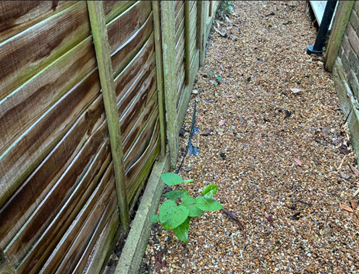
A privately owned detached home in Surrey with two Japanese knotweed stands, each about 1 m², located next to a boundary fence and extending into a neighbouring property, with visible growth also present on surrounding land.
Because the knotweed was close to boundaries and neighbouring land, there were concerns about ongoing spread and potential issues with lender acceptance.
A professional assessment confirmed both stands and highlighted cross-boundary considerations. A formally documented treatment programme, combining targeted spraying and stem injection with a glyphosate-based herbicide, was recommended.
The documented management plan addressed on-site growth and neighbouring land risks, providing reassurance for lenders, with treatment costs estimated at £4,667.20 + VAT.
Yes. We carry out Japanese Knotweed excavation and removal throughout Surrey, including Guildford, Woking, Farnham, Epsom, Redhill, and Staines. We work on residential gardens, commercial properties, and development sites of all sizes.
Japanese Knotweed is increasingly found across Surrey, particularly near riverbanks, railway lines, brownfield land, and older urban developments. Properties in suburban towns and rural villages are also at risk due to historic land disturbance.
Excavation is often recommended in Surrey when:
A property sale or mortgage is being arranged
Knotweed is close to buildings, walls, or drainage systems
Construction, landscaping, or redevelopment work is planned
Excavation provides a fast and permanent solution, ensuring knotweed is fully removed.
All removed Japanese Knotweed is classified as controlled waste under UK law. It is transported by licensed waste carriers and disposed of at authorised landfill facilities, fully compliant with Surrey County Council regulations and national environmental guidelines.
Before excavation, we perform a site-specific risk assessment, especially in densely populated towns, terraced housing, or properties near shared boundaries or public land. Work is carefully managed to prevent spread and minimise disruption.
Yes. All excavation projects in Surrey can include a long-term company guarantee, with the option of an insurance-backed guarantee. These are widely accepted by mortgage lenders, solicitors, and surveyors, providing reassurance for property transactions.