
If you’re buying, selling, or managing property in Wales, Japanese knotweed, as an invasive plant species, often only comes to light once a transaction or formal review is underway.


Most people don’t actively look for Japanese knotweed. It usually comes up during due diligence — a survey raises a question, a buyer seeks reassurance, or a lender requests confirmation. At that point, uncertainty often matters more than the plant itself.
In Wales, residential properties often include larger private plots and long-established land, where knotweed is treated as a due-diligence issue — identified through professional assessment rather than assumed to be present.
Outcomes are usually determined less by the plant itself and more by how clearly the situation is assessed and documented.
In Wales, property surveys are usually when knotweed issues come to light, rather than properties being suspected of infestation in advance.
Common trigger points include:
When multiple plots of land are involved, uncertainty can quickly arise if boundaries haven’t been clearly defined.
When knotweed questions are addressed early, they are usually managed proportionately and without derailing plans. Where clarity comes later, disclosure obligations and unanswered questions can lead to hesitation or delay. A Japanese knotweed infestation can impact property value, so the sooner clarification of knotweed occurs, the less financial effects will take place.
Across all scenarios, clarity supports informed decisions and smoother progress.
| Situation | Why clarity is needed |
|---|---|
| Selling a property | Clear disclosure supported by assessment helps prevent last-minute complications. |
| Buying a property | Understanding the position early avoids surprises after commitment. |
| Larger private plots | Multiple areas may need to be considered and documented as part of a single property review. |
Japanese knotweed does not automatically block property transactions in Wales when it has been properly assessed and documented.
However, if the situation is unclear—especially on larger plots—surveyors and legal advisers may request further investigation until it is fully clarified.
We provide professional Japanese knotweed surveys, treatment and removal services throughout Wales, including major towns and cities such as Cardiff, Swansea, Carmarthen, Neath and Port Talbot, as well as surrounding areas across North and South Wales.
If Japanese knotweed is present—or you’re unsure whether it needs to be disclosed—the best next step is to get site-specific advice tailored to your property, rather than relying on assumptions.
We establish whether a formal Japanese knotweed assessment is actually needed, based on your specific situation rather than assumptions.
We advise on what type of reporting would be appropriate, proportionate and acceptable to lenders, solicitors or planners.
By dealing with likely questions at the right stage, we help prevent delays, disputes or last-minute requests later in the process.
Handled early, knotweed becomes a managed factor, not a lingering constraint.
A private property in Wrexham contains four separate Japanese knotweed stands, ranging in size from about 5 m² to 150 m², scattered across different parts of the plot.
The presence of multiple stands, along with the potential spread of rhizomes through soil or other vectors, created a risk of ongoing reinfestation across the property.
A professional assessment identified Stand 3 as the main source on the property. A targeted treatment program using a professional-grade glyphosate herbicide was recommended to achieve long-term control across all affected areas.
This coordinated approach created a documented management plan for the property, allowing all identified stands to be controlled, with treatment costs estimated at £11,980 + VAT.
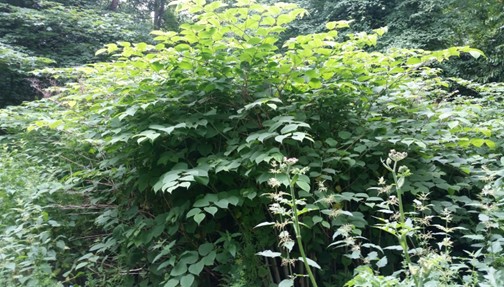
Yes. We provide Japanese Knotweed excavation and removal services throughout Wales, covering North, Mid, and South Wales. This includes areas such as Cardiff, Swansea, Newport, Wrexham, Bangor, Aberystwyth, and surrounding rural locations. Both residential and commercial sites are supported, subject to access and environmental requirements.
Japanese Knotweed is widespread across Wales due to its extensive river systems, high rainfall, and historic land use. Infestations are commonly found along riverbanks such as the Taff, Severn, and Wye, transport corridors, former industrial land, and redevelopment sites.
Excavation is often the preferred option where:
Property sales or remortgaging are time-sensitive
Development, infrastructure, or groundwork is planned
Knotweed is affecting retaining walls, buildings, or steep terrain
In many Welsh locations, excavation provides a faster and more definitive solution than multi-year herbicide programmes.
All excavated Japanese Knotweed material is classed as controlled waste under UK environmental legislation. We use licensed waste carriers and dispose of the material at approved landfill facilities in Wales that are authorised to accept invasive plant waste.
Yes. A detailed site-specific risk assessment is undertaken before excavation, particularly for properties near watercourses, shared boundaries, sloped land, or public spaces. Works are carefully controlled to prevent spread and protect adjacent land.
Yes. Excavation works in Wales can be supplied with a long-term guarantee, with insurance-backed options available. These guarantees are commonly required by mortgage lenders, solicitors, and surveyors during property transactions.